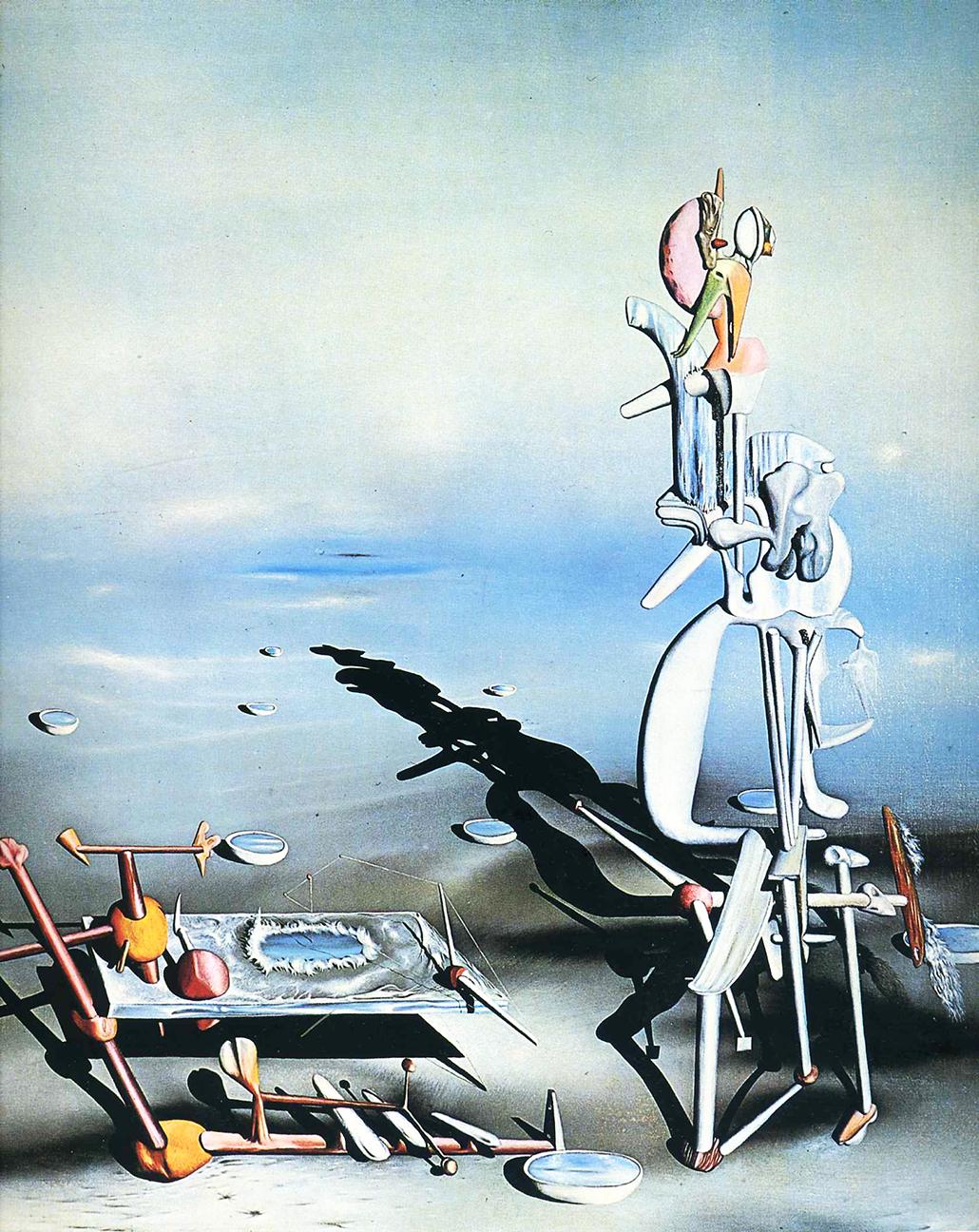
Yves Tanguy was a French Surrealist painter best known for his mysterious, dreamlike landscapes filled with strange, unidentifiable forms.
Tanguy’s paintings are characterized by vast, empty spaces, often resembling deserts or seashores, inhabited by biomorphic shapes that seem both organic and mechanical. These forms float, melt, or stand like fossils in an imagined world, creating a strong sense of silence, infinity, and psychological tension. His precise, smooth painting technique gives these unreal scenes a striking clarity, enhancing their uncanny atmosphere.
Most Popular Painting: Indefinite Divisibility (1942)
Tanguy’s most famous and widely recognized painting is Indefinite Divisibility (1942). The work presents a barren, endless landscape populated by elongated, abstract forms that appear to drift or stand in a frozen, timeless space. Painted during World War II, the composition reflects a sense of isolation and uncertainty, often interpreted as a response to the global turmoil of the era.
With its cool color palette, meticulous detail, and surreal imagery, Indefinite Divisibility exemplifies Tanguy’s mature style and his ability to transform the subconscious into a convincing visual reality. The painting has become an iconic example of Surrealist landscape painting and remains central to Tanguy’s legacy.