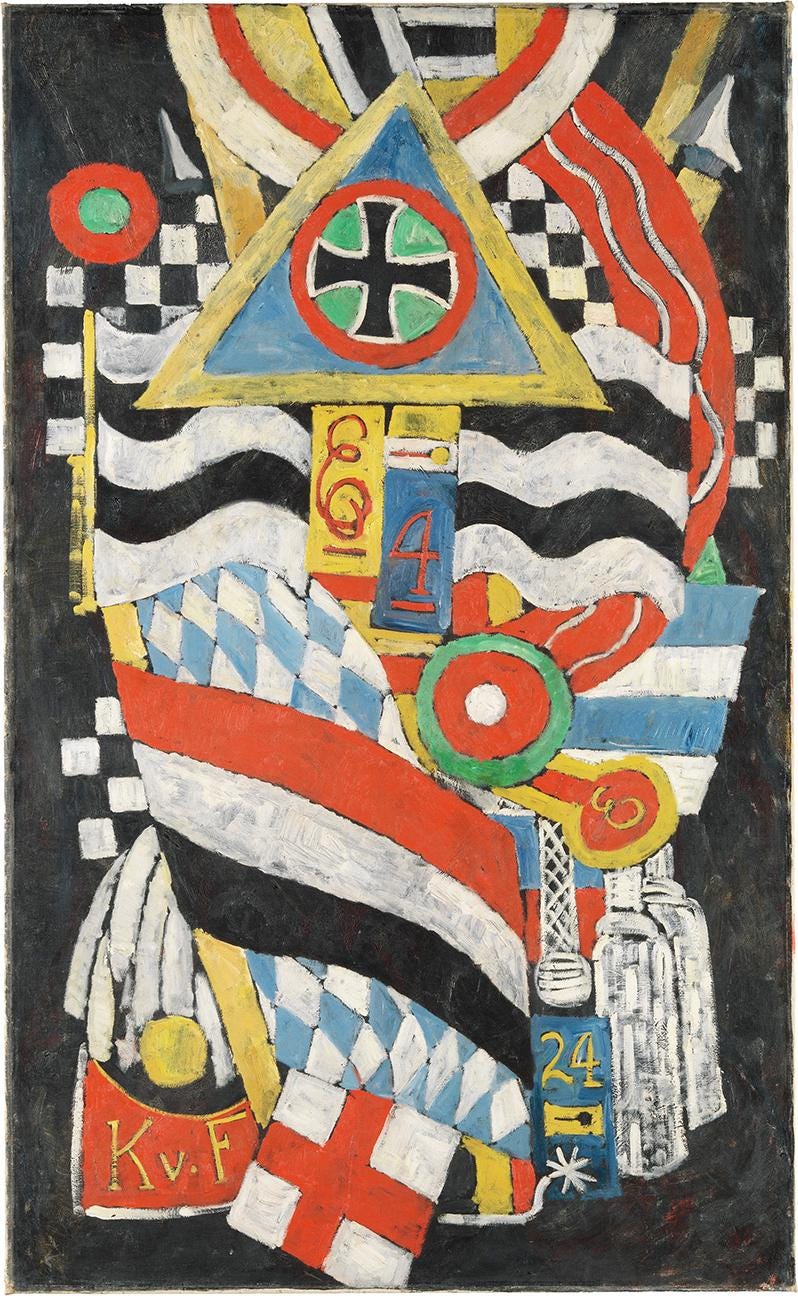
Marsden Hartley was an American modernist painter known for his bold use of color, symbolic imagery, and emotionally charged compositions. He absorbed elements of Cubism, Expressionism, and German modern art, yet developed a highly personal visual language rooted in spirituality, identity, and national symbolism. Hartley’s work evolved significantly over time. His early paintings were often lyrical and mystical, influenced by transcendental philosophy. During his Berlin period (1913–1915), his art became more abstract and symbolic, filled with military emblems, flags, numbers, and bold color blocks. Later in life, after returning to the United States, he focused on landscapes and figures inspired by the rugged coast of Maine, painting with a more direct, expressive realism.
Most Famous Painting: Portrait of a German Officer (1914)
Hartley’s most celebrated work is Portrait of a German Officer (1914). Rather than depicting a literal portrait, the painting is a symbolic memorial to a Prussian officer. The composition is made up of military insignia, iron crosses, numbers, and vivid colors, reds, blacks, blues, and whites, arranged in a powerful, abstract design. This painting is considered a landmark of American modernism. It combines abstraction with deep emotional content and reflects Hartley’s engagement with German Expressionism. Today, Portrait of a German Officer is widely regarded as his masterpiece and a defining work of early 20th-century avant-garde art in the United States.