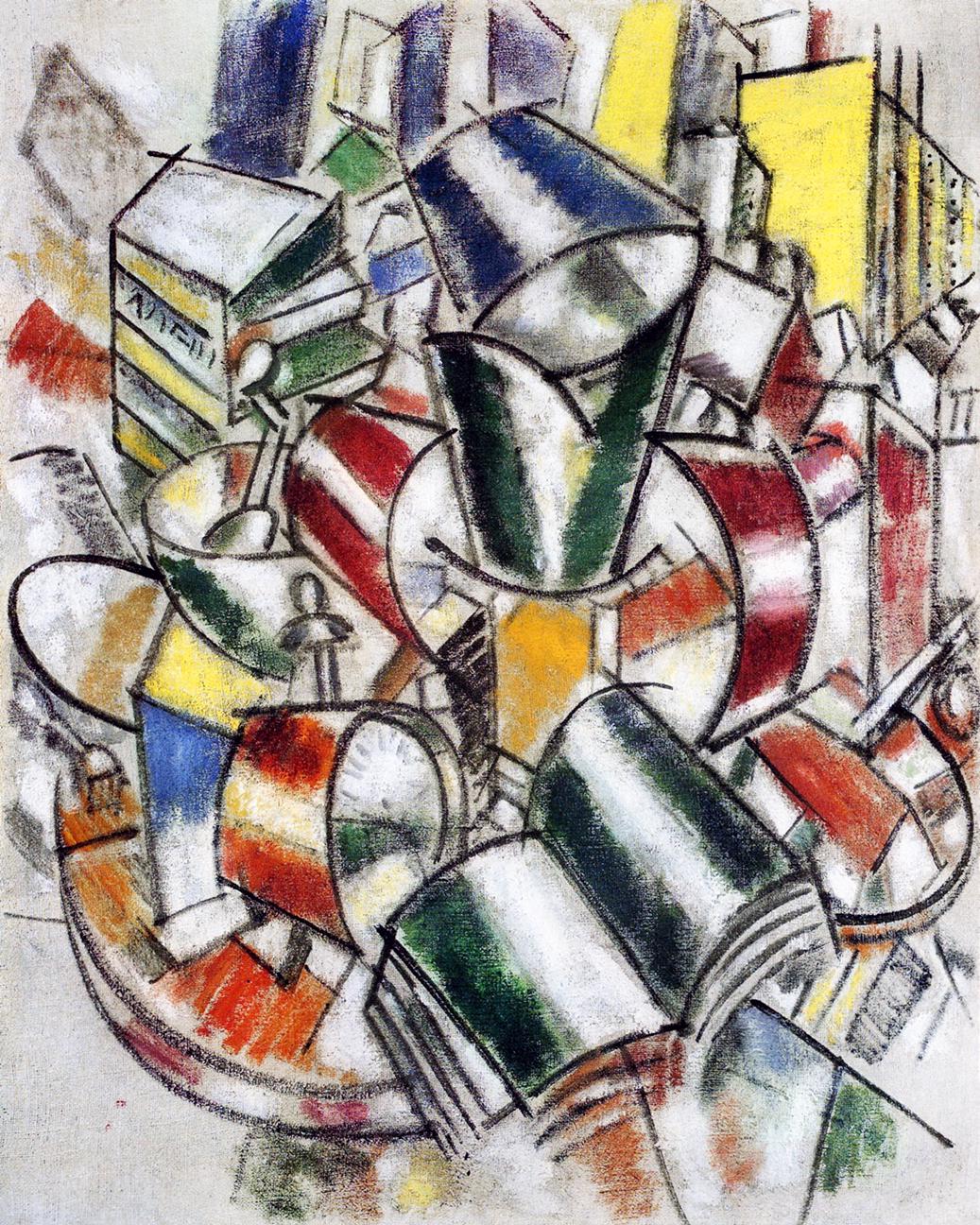
Fernand Léger’s Composition (Nature morte) (1914) is a striking Cubist‑inspired still life that reflects his early move toward abstraction, using bold geometric forms and mechanical rhythms to transform everyday objects into a modern visual language.
Painted during World War I, the work shows Léger’s shift from traditional Cubism toward a more mechanical, abstract style.
Everyday still‑life elements (bottles, vessels, fruit) are broken down into cylinders, cones, and spheres, emphasizing structure over naturalism.
The composition reflects Léger’s fascination with modern industrial aesthetics, anticipating his later “machine aesthetic” works.
Strong contrasts of color and form create a dynamic rhythm, turning a simple still life into a bold statement of modernity.
Léger was deeply influenced by Cubism (Picasso, Braque) but developed his own approach, often called “Tubism” for its cylindrical forms.