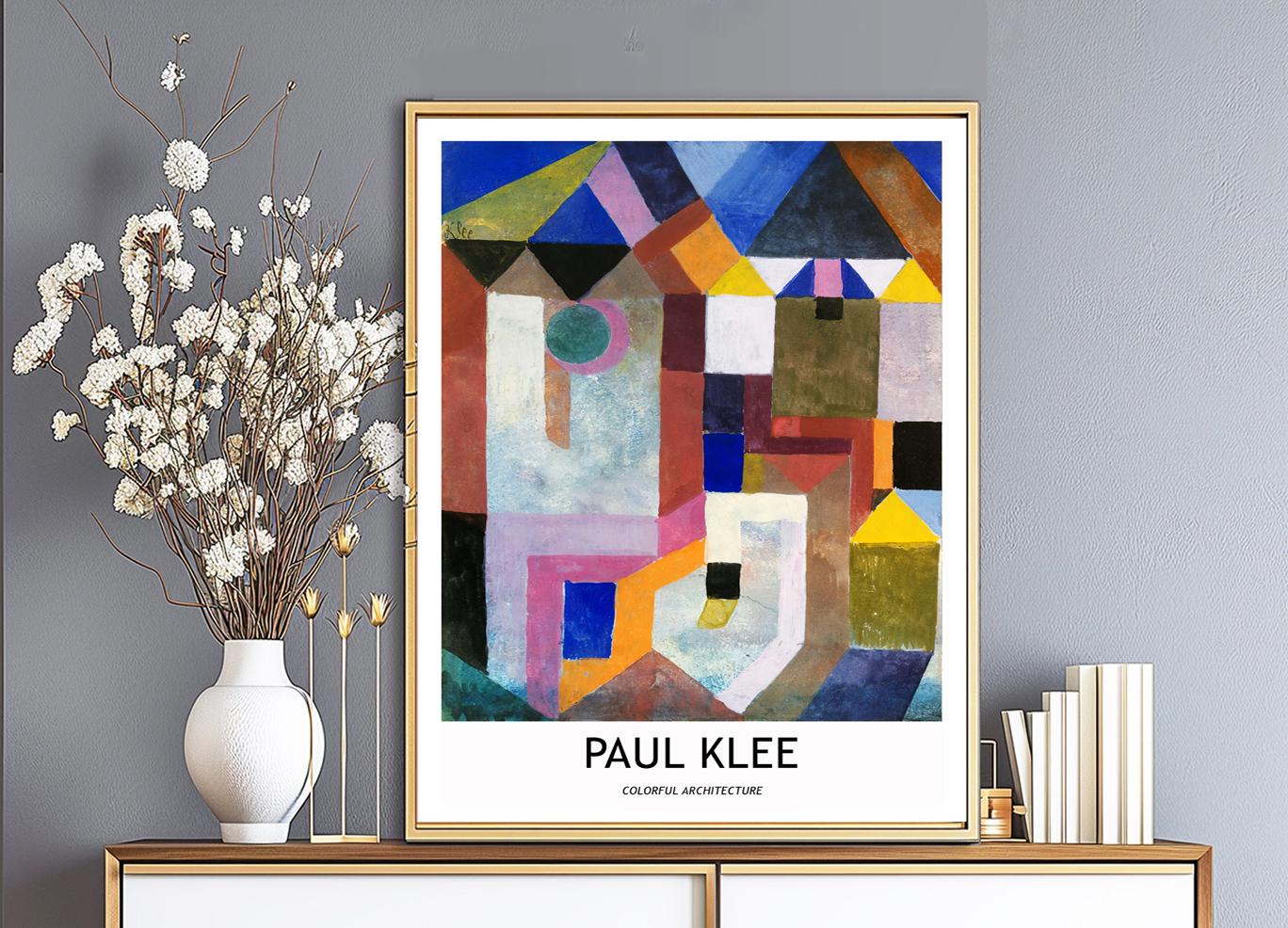
Paul Klee developed a style so individual that it resists strict categorization. His work draws from Expressionism, Cubism, Surrealism, and even Orientalism, yet it never fully belongs to any single movement. Instead, Klee created a visual vocabulary of signs, symbols, grids, playful geometry, and dreamlike color harmonies.
Although he began as a draftsman working mostly in black and white, Klee eventually became one of the great theorists of color. His color palettes often feel musical—no surprise, given that he was trained as a violinist.
Klee believed that art should not imitate the visible world but reveal the invisible. His lines often behave like living creatures—wandering, dancing, or whispering across the page.
Paul Klee - Colorful Architecture